Sleep and breathing: describe what happens
The breathing prompts ask about difficulty breathing through the nose, daytime mouth breathing, and sleeping with the mouth open. The sleep prompts include snoring or loud breathing, tossing during sleep, and grinding or tooth wear. Describe what you have actually noticed and how often it occurs.
Separate an observation from its interpretation. “I hear loud breathing most nights” gives the clinician something to investigate. “The airway must be too small” jumps ahead of the assessment. Previous reports or a record of when concerns occur may help the discussion, but screening answers do not measure the airway or diagnose sleep apnea.
Daily energy and jaw structure: keep the questions distinct
The daily-life prompts include tiredness, irritability, and difficulty focusing. The structural prompts include a recessed-looking lower jaw, crowding, and bite concerns such as a crossbite or open bite. These are different kinds of information, even when they are discussed during the same appointment.
Ask how each concern will be evaluated. A parent's concern about focus deserves attention without assuming that a dental procedure will resolve it. Likewise, a bite concern may justify orthodontic assessment without establishing a sleep disorder. The aim is to investigate possible relationships while preserving the distinction between observation and diagnosis.
Speech and ENT history: bring the background
The speech section asks about a lisp, tongue pushing, and a history involving a tongue restriction or feeding concerns. The ENT section includes ear infections or tubes, allergies or congestion, and tonsil or adenoid concerns, including previous removal. These prompts invite a fuller history rather than prove a single explanation.
ASHA describes oral-function assessment as collaborative work that may involve speech-language, dental, and medical professionals. Tell the team which issues have already been assessed and what remains unresolved. A previous procedure belongs in the history; it does not, by itself, answer whether a current symptom needs further investigation.
Make the six areas work together
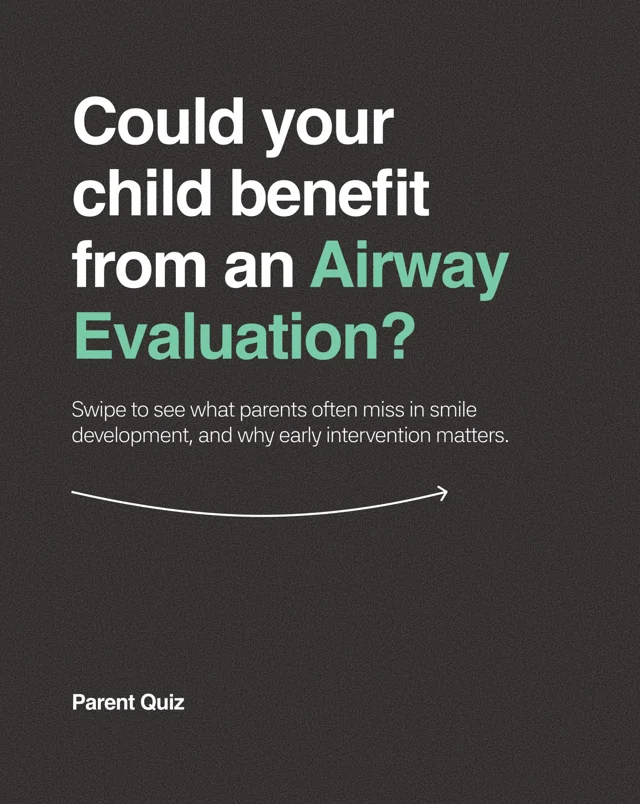
Before submitting the airway evaluation, choose your main questions and gather records of earlier assessments. Identify what you hope to understand: a sleep concern, a growth question, a functional difficulty, or how existing recommendations fit together.
At the consultation, ask for a practical next-step plan. Which findings need examination? Is referral appropriate? What can be monitored, and who will follow up? The value of a broad evaluation is that it helps organize care around the child, rather than treating every checked box as an indication for the same treatment.
A structured assessment is a differential diagnosis, not a checklist score
A multi-domain airway evaluation is most useful when each observation answers a different clinical question. Sleep history addresses nocturnal respiratory symptoms. The dentofacial examination addresses transverse and sagittal relationships. Oral-function assessment considers resting posture, mastication, swallowing, and speech-related concerns. Nasal and pharyngeal symptoms may require medical evaluation. Findings across these domains can coexist without sharing a single cause.
For example, a child with crowding and habitual snoring may have an orthodontic indication and a separate reason for medical sleep assessment. Neither finding establishes that crowding caused the snoring. A problem-oriented record should identify the observation, the suspected mechanism, the clinician responsible for evaluating it, and the evidence needed to confirm or reject the working explanation. This keeps treatment planning more precise than adding up visible signs.
How to turn the six areas into a coordinated clinical record
The next step is to translate broad categories into reproducible observations. “Narrow palate” becomes a description of arch relationships and supporting measurements. “Tongue concern” becomes the particular movement or functional task that is limited. “Poor sleep” becomes a time course, symptom frequency, and associated daytime concerns. The purpose is to make the referral intelligible to another clinician, not to assign every finding an airway origin.
Previous records are especially valuable when comparing development over time. Dental photographs, appliance history, eruption stage, and medical reports help distinguish a longstanding pattern from a recent change. Behavioral concerns should be documented with the same care: an association between sleep-disordered breathing and behavior does not establish that one child’s attention difficulty is caused by an airway disorder. Each relevant concern warrants evaluation within the appropriate professional scope.
Bring the conversation to your visit.
- Which of these observations need separate medical, dental, or speech assessment?
- What can this screening tell us, and what still needs examination or testing?
- Who will review the findings together and coordinate follow-up?
Supporting studies & resources
These resources add clinical context to the original post. Each publication should be read with its study population, methods, and outcomes in mind.
- Policy on Obstructive Sleep Apnea (OSA) American Academy of Pediatric Dentistry · 2026 · Professional policy
- Orofacial Myofunctional Disorders American Speech-Language-Hearing Association · Undated · Professional guidance
- Management of the Developing Dentition and Occlusion in Pediatric Dentistry American Academy of Pediatric Dentistry · 2024 · Clinical best practice
- Sleep-disordered breathing in a population-based cohort: behavioral outcomes at 4 and 7 years Pediatrics · 2012 · Longitudinal cohort study